Kitchen Chimney & Exhaust Hole Core Cutting in Kanpur
Namaste. If you are installing a new kitchen chimney in your home, you've probably realized by now that the real headache isn't picking between an Elica or a Faber—it's figuring out how to get that exhaust pipe out of your kitchen. Every week across Kanpur, from Swaroop Nagar to Kidwai Nagar, we get calls from homeowners who have a brand-new chimney sitting in a box, but their mistri is scratching his head about making the hole in the wall.
Why You Need a Properly Drilled Exhaust Hole
A kitchen chimney works by sucking up cooking fumes, oil, and smoke, and pushing it outside. To do this, the chimney duct (which is usually a 6-inch round or 6x6-inch square pipe) needs to pass through an external wall.
Some people try to have their rajgir break a hole using a hammer and chisel. Let me tell you straight—this is a bad idea. Bashing a 9-inch brick wall with a hammer shakes the whole structure. It ruins the plaster on both sides, creates uneven edges, and leaves a jagged hole that is impossible to seal properly. With our Dongcheng diamond core drills running between 1200-2200 RPM, we cut a clean, circular cylinder through the wall. Minimal vibration, significantly less dust, and your wall stays strong.
The Golden Rule: Check Size Before You Call
One of the most common questions I get asked on the phone is, "Bhaiya, kitne inch ka hole karna hai?" (Brother, what size hole is needed?).
Most standard chimney brands like Hindware, Glen, Elica, and Faber use a 6-inch round exhaust duct. However, some heavy-duty or premium models use a 7-inch duct. Before you call us for chimney hole cutting kanpur, look at the spec sheet inside your chimney box. Never guess the size.
If we drill a 6-inch hole and your pipe is 7 inches, the pipe won't fit. If we drill an 8-inch hole for a 6-inch pipe, you're left with huge air gaps around the duct where rainwater, lizards, and insects will enter your kitchen. We charge for the hole we cut, so let's get it right the first time.
Positioning the Hole: Location is Everything
The exhaust hole should be on an external wall, positioned directly behind or slightly above where the chimney unit will sit. The goal is to keep the duct path as short and straight as possible.
You wouldn't believe the mistakes we see. Just last month in Kakadeo, a homeowner had a local mistri break a hole through an internal partition wall because it was easier than drilling the outer 9-inch brick wall. The result? Their exhaust pipe vented directly into their dining room. Now the whole house smells like frying fish and mustard oil every time they cook. Always vent to the outside.
The Downward Tilt Trick
Here is a contractor secret that a lot of inexperienced guys miss. When we drill an exhaust hole, we do not drill it completely level. We give the core drill a slight downward tilt towards the outside—about 2 to 3 degrees.
Why? Because when the monsoon hits Kanpur, rain will beat against that external wall. If the hole is completely level or tilted inward, rainwater will travel down the duct pipe and straight into your chimney motor, ruining an expensive appliance. That slight downward slope ensures any water drains outside naturally.
The Core Cutting Process: What to Expect
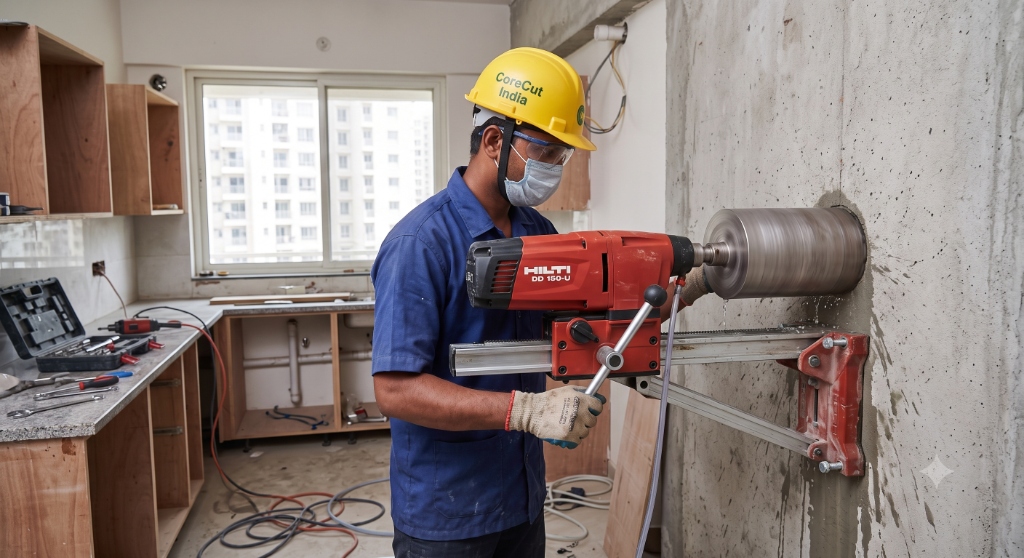
When our team arrives at your home in Kalyanpur or Jajmau, the first thing we do is mark the exact center of the hole based on your chimney's placement. Then, we mount the drill stand firmly to the wall using a heavy-duty anchor bolt. This ensures the drill bit doesn't wander or slip across your beautiful kitchen tiles.
The Dongcheng machine is locked onto this stand, and we slowly advance the 6-inch or 7-inch diamond core barrel into the wall. Because it's a wet drilling process, we use a small water pump to feed water into the cut. This keeps the diamond segments from burning up and traps the brick dust as a slurry instead of letting it fly all over your clean kitchen counters. Once we break through the other side, we pull out the solid cylindrical core of the wall, unbolt the stand, and wipe down the area.
Contractor Tip: Brick Wall vs RCC Wall
When planning where to mount your chimney, try to ensure the exhaust hole goes through a standard brick wall (usually 4-inch or 9-inch thickness). If your kitchen layout forces the exhaust hole to land right on a structural RCC beam or column, the job becomes much harder.
Cutting through solid M25 or M30 grade concrete filled with 12mm or 16mm TMT rebar takes longer and costs more than cutting through soft red brick. While our core drills can easily slice through the steel rebar, it's always better for your building's structural integrity to put utility holes in the brick infill panels rather than the main load-bearing beams if you have the choice.
What Happens After Drilling: The Duct Pipe
Our job is to provide the core cutting, but you should know how the rest of the installation works. After we finish the chimney hole cutting kanpur, the chimney installation technician will slide a PVC or flexible aluminum duct pipe through the hole.
Because our diamond core cut is circular and uniform, the 6-inch pipe will slide into the 6-inch hole snugly. Any tiny gaps around the edges should be sealed with silicone sealant or expanding foam from both the inside and outside. Finally, an exterior rain cap or cowl is attached on the outside to keep birds and rats out.
Common Disasters We See on the Job
After years of doing this across Kanpur, we've fixed a lot of botched jobs. Here is what to avoid:
- The Hammer and Chisel Mess: Trying to chip a 6-inch circle out of a wall by hand always results in a 10-inch irregular crater. You will spend extra money calling a mason to patch the plaster around the pipe.
- Holes at the Wrong Height: If the hole is placed too high above the chimney, the exhaust pipe has to bend awkwardly. Every sharp bend in the duct reduces the suction power of your chimney motor. Keep the path direct.
- Guessing the Outer Wall: Drilling from the inside out without measuring what is on the other side. We always check the exterior first to make sure we aren't going to drill straight into a plumbing line, an electrical conduit, or your neighbor's property boundary.
Chimney Hole Cutting Pricing in Kanpur
For a standard kitchen chimney installation, the pricing is straightforward. If we are drilling a standard 6-inch or 7-inch hole through a normal brick wall (up to 9 inches thick), the cost is typically between Rs 1000 to Rs 1200 per hole.
If the hole happens to hit a heavy RCC concrete beam with thick steel rebar, or if the wall is exceptionally thick (like in some older houses in Civil Lines or Cantonment areas), the price will be based on an on-site inspection. We bring all our own equipment, including the water pump needed to keep the diamond bit cool, so you don't have to worry about anything except showing us where you want the hole.
Frequently Asked Questions (FAQ)
Will drilling the hole damage my kitchen tiles?
We use diamond core drilling, which is designed to reduce structural disturbance. The diamond bit grinds through the tile and brick cleanly. While no construction work is entirely mess-free, this method creates a neat, round hole without cracking the surrounding tiles, unlike hammer drilling.
How long does it take to cut a 6-inch chimney hole?
In a standard 9-inch brick wall, the actual cutting time is usually 20 to 30 minutes once the machine is mounted and set up. If we hit an RCC beam with heavy rebar, it might take 45 minutes to an hour.
Do you provide the plastic duct pipe and chimney installation?
No, we specialize in the core cutting itself. We drill the hole cleanly to the requested diameter. You will need to have the chimney company's technician or your own electrician do the final mounting and pipe insertion.
Is there a lot of dust during the cutting?
We use a wet drilling method where water flows over the drill bit at a controlled rate to keep it cool. This water captures almost all the dust, turning it into a slurry. It is significantly less dusty than dry grinding, but there will be some water runoff, so we recommend clearing items away from the wall directly below the drill site.
Need a Kitchen Chimney Hole Today?
Contact CoreCut India today for a free site assessment and transparent quotation.
PricingProjects Call Now: 9236323804